Thematic Brief
Addressing Violence Against Women and Girls (VAWG)
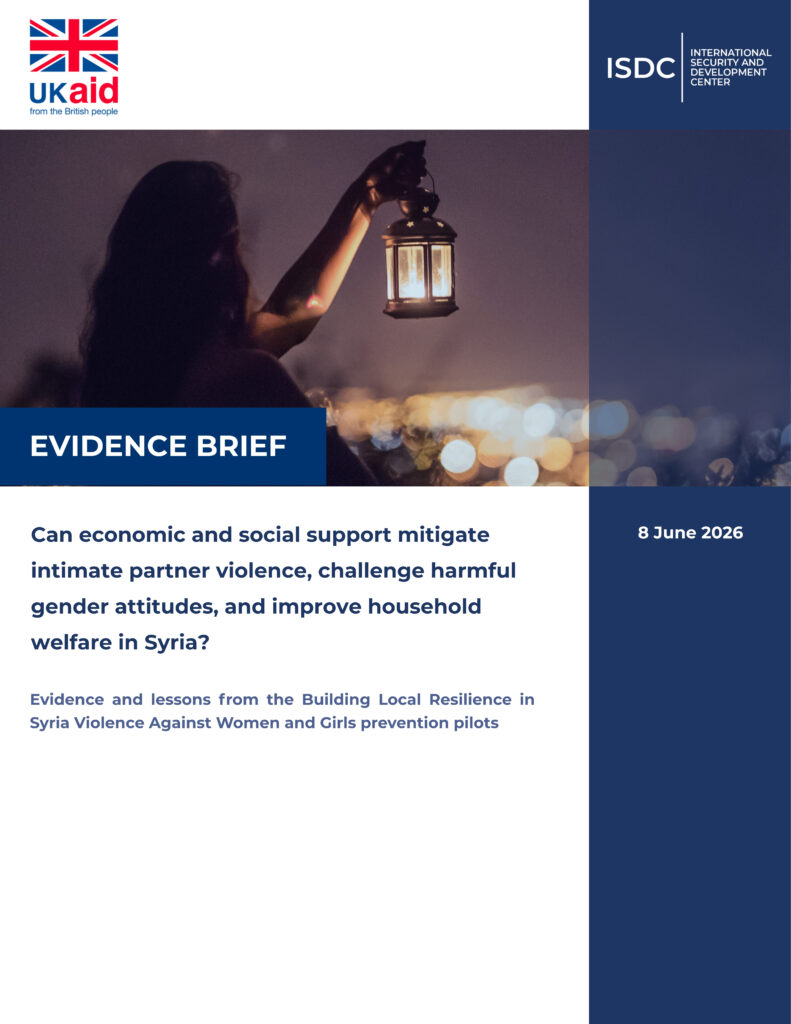
Fourteen years into the Syrian crisis, women and girls continue to bear the brunt of a deepening humanitarian emergency, facing widespread gender-based violence and systemic discrimination. In response, the Food and Agricultural Organisation (FAO) and the Syria Resilience Initiative (SRI) are piloting several interventions under BLRS to address violence against women and girls across different settings in Syria.
About VAWG pilot intervention
Since the start of the conflict, risks of intimate partner violence (IPV) and gender-based violence (GBV) have increased in Syria. The Building Local Resilience in Syria (BLRS) programme addresses these challenges through its Violence Against Women and Girls (VAWG) interventions, which target economic and physical IPV and economic violence perpetrated by non-intimate partners, including other family members and those in the economic sphere. Implemented by the Syria Resilience Initiative (SRI) and the Food and Agricultural Organization (FAO) in partnership with the United Nations Population Fund (UNFPA), the VAWG interventions combine livelihood support with couples’ curriculum that promotes healthy relationships, joint decision-making, and more equitable gender attitudes within households and communities.
This thematic brief presents the BLRS study objectives and summarises key findings from the VAWG intervention evaluations in Syria.
What are VAWG and IPV?
The United Nations defines VAWG as “any act of gender-based violence that results in, or is likely to result in, physical, sexual, or mental harm or suffering to women” (Declaration on the elimination of violence against women, 1993). Intimate Partner Violence (IPV) is a form of VAWG and refers to any behaviour within an intimate relationship that causes economic, psychological, physical, or sexual harm to one’s partner.

About one in three women worldwide has experienced physical or sexual IPV (from a partner or non-partner) in her lifetime, while about a quarter of women have experienced physical or sexual IPV (World Health Organization Violence Against Women Fact Sheet, 2023).
Common measures of IPV

Programme approach

The problem
Economic and physical violence against women, including by intimate partners, other family members and in economic spheres, are rooted in social norms, power imbalances between women and men, and patriarchy. This violence violates women and girls’ rights, constrains their choices and agency, and negatively impacts their ability to participate in, contribute to and benefit from economic opportunities.
BLRS approach

Impact
Women and girls’ wellbeing, safety, dignity and agency are improved, and greater realisation of their right to be free from GBV.
Programme interventions
Under the BLRS programme, two complementary interventions were implemented to address IPV at the household and community levels:
FAO–UNFPA pilot (Central & South Syria)
Implemented in Homs and Rural Damascus through Farmers Field Schools (FFS)
Couples participated in Economic and Social Empowerment (EA$E) facilitated discussions on gender roles and attitudes, financial management, and early marriage
At the community level, Dimitra Clubs brought men, women, and youth together to challenge harmful gender norms and support local action for gender equality
Impact Evaluation
Two-stage cluster randomized controlled trial testing agro-processing vouchers + the EA$E programme (treatment) compared to the agro-processing voucher intervention alone (control)
Sample size: 581 couples or 1,162 individuals
SRI pilot (Northeast Syria)
Implemented in Al-Hasakah in collaboration with local partners
Combined a livelihoods component (microgrants and training for small enterprises) with a 21-session couples curriculum adapted from the Indashyikirwa model, focusing on power dynamics, emotional regulation, financial cooperation, and shared decision-making
Impact Evaluation
Cluster randomized controlled trial testing SME grants + the Indashyikirwa couple-curriculum compared to SME grants alone (control)
Sample size: 600 couples or 1,200 individuals
Outcomes measured
Women’s reported experiences of economic, emotional and physical IPV in the past 12 months
Men’s self-reported perpetration of economic IPV in the past 12 months
Women’s and men’s decision-making regarding household and agricultural decisions
Attitudes and norms around wife-beating, inequitable gender roles, child marriage and women’s right to work or speak publicly
Prevalence of IPV in Syria
Across BLRS programme areas, intimate partner violence remains widespread:

In Central and South Syria (Homs and Rural Damascus), 55 % of women reported emotional IPV and 46 % reported economic IPV at baseline in 2025.

In Northeast Syria (Al-Hasakah Governorate), 74 % of women reported experiencing at least one form of IPV in the previous 12 months, including emotional IPV (65 %), economic IPV (44 %), and physical IPV (27 %) at baseline in 2023 and 2024.
Impact evaluation findings
The BLRS impact evaluations show that combining livelihood support with structured gender and communication sessions holds promise in reducing IPV and improving spousal relationships in Syria.
Women’s reported experiences of IPV declined
Find out more
Women reported reductions in their experiences of any economic IPV (35 percentage points) and emotional IPV (26 percentage points) with the EA$E programme, and being hit (6 percentage points) and having their arms twisted (5 percentage points) with the Indashyikirwa programme in the 12 months before the survey.
Women’s participation in key household and financial decisions improved, supporting more balanced, cooperative relationships.
Find out more
Women reported improvement in their sole and joint decision-making, for example on who works outside the house, child’s health and education, and child marriage, across both programmes.
Gender attitudes among participants, mostly women, became more equitable.
Find out more
Participants, especially women, reported more gender-equitable attitudes, particularly around rigid gender roles across both programmes.
Changes to men’s self-reported perpetration of economic IPV and gender attitudes were limited
Find out more
Men’s reports of perpetrating economic IPV and gender attitudes showed minimal change in both programmes. Short-term shifts in men’s outcomes were smaller and less consistent than those observed for women.

This project is funded by UK aid from the UK government.