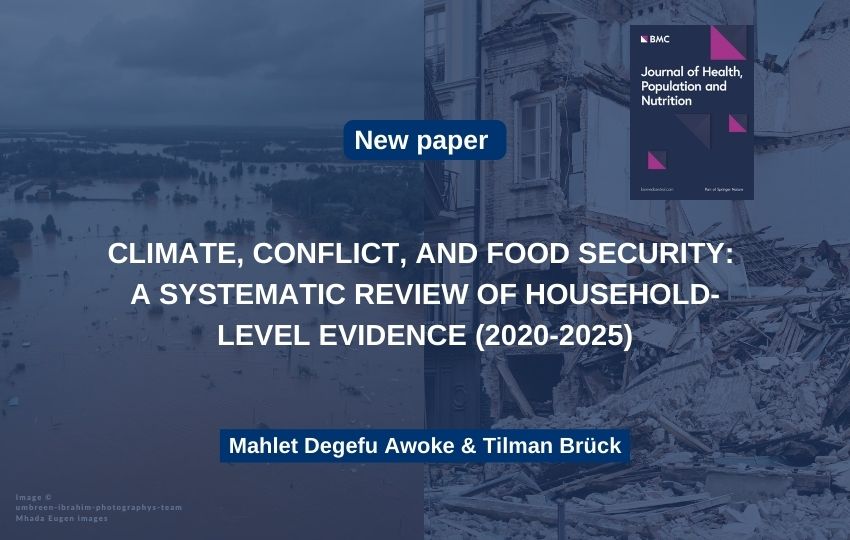
Climate and conflict crises are increasingly occurring together, creating compounded risks for household food security.
In this newly released paper, authors Mahlet Degefu Awoke and Tilman Brück synthesize evidence from 37 studies published from 2020 to 2025 on the effects of climate crises (such as drought, storms, or floods), violent conflict (such as war and institutional fragility), and their interactions on household food security.
The result is a significant research gap: While 51% of the studies focus on climate, and 38% focus on conflict, only 11% analyze the combined, compounding effects of both crises. Furthermore, the paper reveals that 68% of the evidence is based on cross-sectional surveys, which offer limited insight into long-term trajectories.
Also of note: Only a small number of studies integrate geocoded climate or political violence datasets with household surveys, and few studies estimate interaction or spillover effects.
Overall, the paper, published open access in the Journal of Health, Population and Nutrition, demonstrates that across studies, climate crises, conflict, and their intersection are associated with reduced consumption, lower dietary diversity, and greater coping burdens. The extent of these impacts varies depending on household assets, agroecology, and institutional or humanitarian support.
These findings underscore the need for longitudinal and spatially or contextually explicit evidence that measures productive resilience rather than only short-term consumption smoothing.