An increasing proportion of the world’s poor live in fragile states, and efforts to build economic and social stability increasingly focus on those settings. Thus, understanding whether, to what extent, and how these efforts achieve their goals, remains important.
In our impact assessment of SPARK’s LEAD 2 program in Somalia and Tunisia, Neil Ferguson and Tatiana Orozco Garcia tested whether a program designed to help young entrepreneurs to start and grow their businesses contributed to the reconstruction of their societies. Through this work, we sought to understand the extent to which SPARK’s programming has contributed to the employment and social outcomes of the project beneficiaries; to test the extent to which it is possible to support entrepreneurs and business owners in fragile environments; and to contribute important new research and insight to broader debates regarding the extent to which employment programming can contribute to social stability and peace.
The results of the study show that the intervention increased business startup and registration, but the relative income of beneficiaries declined. Moreover, for beneficiaries with positive outcomes, there are associated impacts on social outcomes, including reduced tolerance of violence, increased trust, and increased social participation.
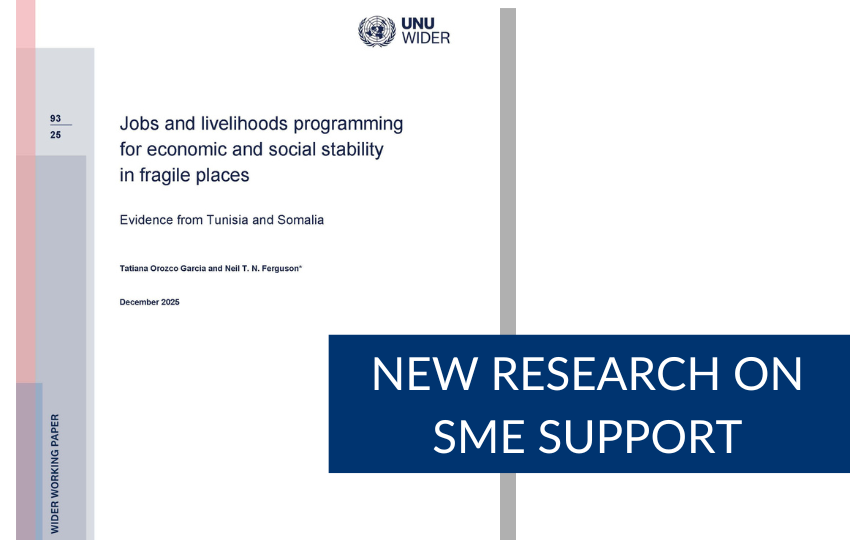
These (and more) results are now available in a UNU-WIDER Working Paper, titled ‘Jobs and livelihoods programming for economic and social stability in fragile places: Evidence from Tunisia and Somalia‘.