Alongside health, peace is a fundamental prerequisite for human development. However, it seems infinitely more difficult to define, measure, or influence peace and its individual experience than to do so for health. What cannot be measured often does not count at all. Therefore, the role of peace in human development is regularly and systematically disregarded […]
Read More
The COVID-19 pandemic caused extensive food insecurity in low-income countries. However, most studies rely on aggregate-level exposure measures, overlooking individual-level heterogeneity and introducing measurement errors that limit causal inference. To overcome these gaps, we examine the impact of COVID-19 exposure on food security in four African countries – Uganda, Tanzania, Sierra Leone, and Mozambique – […]
Read More
Climate and conflict crises increasingly occur together, creating compounded risks for household food security. This review synthesizes evidence from 37 quantitative studies published 2020–2025 on how climate crises (such as drought, storms, or floods), violent conflict (such as war and institutional fragility), and their interactions affect household food security. Most studies examine either climate crises […]
Read More
Heat waves and droughts are each highly damaging to people’s incomes, but little is known of the joint impact on household welfare when these events occur simultaneously. We combine European household level survey data from 2004 to 2022 with high resolution temperature and drought data in a fixed effects econometric regression to investigate the change […]
Read More
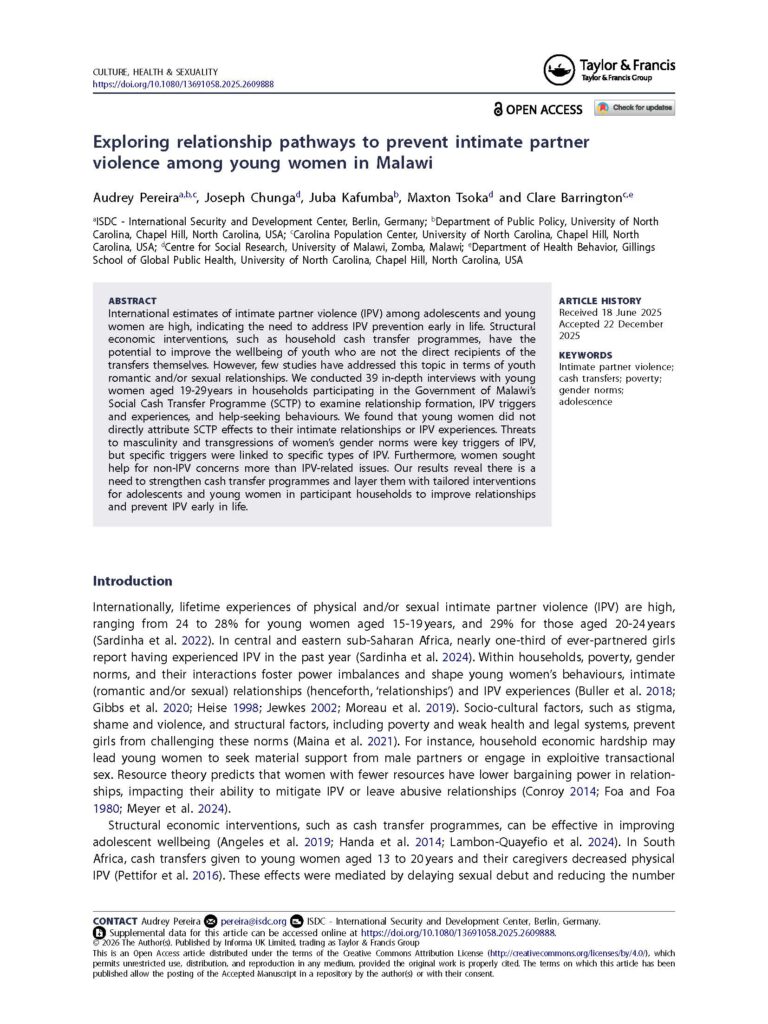
International estimates of intimate partner violence (IPV) among adolescents and young women are high, indicating the need to address IPV prevention early in life. Structural economic interventions, such as household cash transfer programmes, have the potential to improve the wellbeing of youth who are not the direct recipients of the transfers themselves. However, few studies […]
Read More