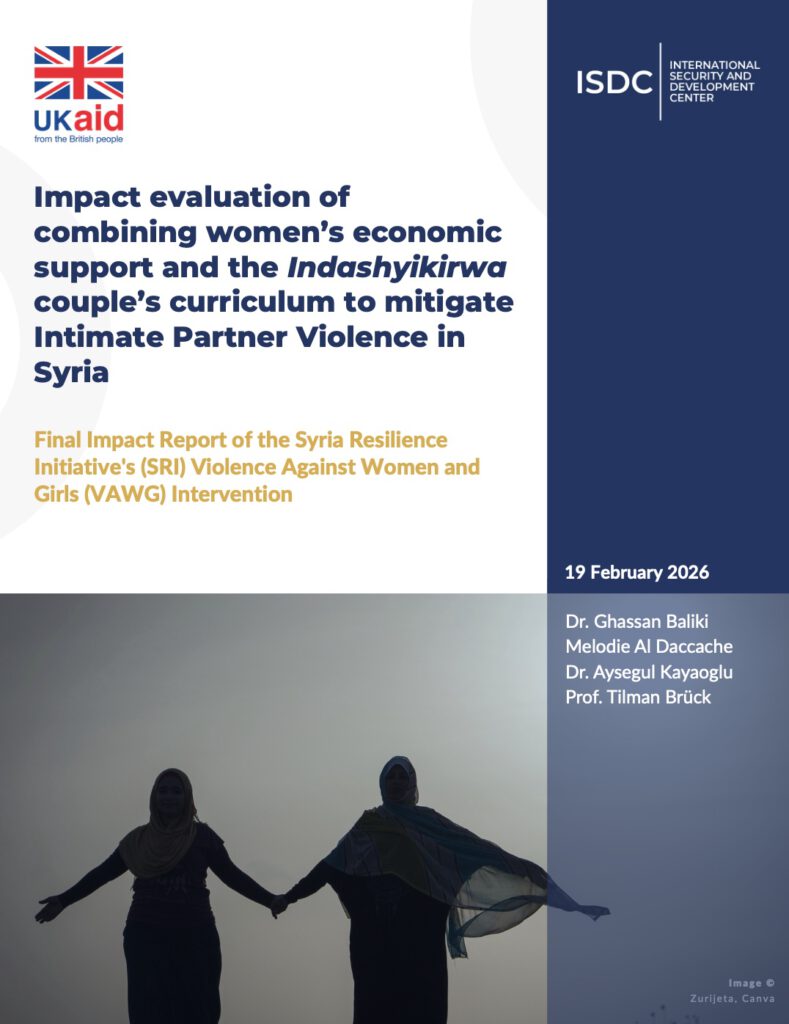
Final Impact Report of the Syria Resilience Initiative’s (SRI) Violence Against Women and Girls (VAWG) Intervention
Executive Summary
Background: Women in Syria face heightened risks of Gender-Based Violence (GBV), including Intimate Partner Violence (IPV), partly due to the conflict. The Building Local Resilience in Syria (BLRS) programme is testing different strategies to transform harmful gender attitudes and reduce IPV. In Al-Hasakah, the Syria Resilience Initiative (SRI) provides cash transfers to women and implements the 21-session Indashyikirwa couple’s curriculum aiming to promote women’s economic and social participation and reduce economic, emotional and physical IPV.
Impact evaluation objective and learning questions: The evaluation causally estimates whether cash transfers, combined with the couple’s curriculum, reduces IPV, strengthens joint household decision-making, promotes gender-equitable attitudes and enhances women’s empowerment.
Impact evaluation design and analysis: ISDC and SRI conducted a cluster randomised controlled trial with 610 couples to estimate short-term impacts using OLS regressions with round fixed effects and village-clustered standard errors, with appropriate robustness checks.
Curriculum attendance: 77% of couples attended 17+ sessions, with similar participation among husbands and wives.
Impact Findings
LQ1:What are the immediate effects of combining the couple’s curriculum with economic support on women’s experiences of economic, emotional, and physical IPV and men’s perpetration of economic IPV?
● Women’s experiences of physical IPV decreased by about 21%, driven by reductions in women being hit and having their arms twisted, with stronger effects among those attending ≥17 sessions.
● No significant changes in women’s economic and emotional IPV overall, except for public belittlement.
● No impact on men’s perpetration of economic IPV; husbands reported increases in self-spending.
LQ2: What are the impacts on the joint decision-making for wives and husbands?
● Women’s joint decision-making improved (work outside home 12 pp; children’s education 18 pp; girl marriage 12 pp).
● Limited changes in men’s reported joint decision-making, suggesting a perception gap.
LQ3: Does the intervention influence women’s attitudes about wife-beating and wives’ and husbands’ gender attitudes?
● Gender-equitable attitudes improved, including reductions in male dominance and acceptance of child marriage.
● Women’s tolerance of violence (-26 pp) and stigma around help-seeking (-32 pp) declined; no changes in men’s attitudes.
● Stronger effects among women attending more sessions.
LQ4: Does the intervention affect women’s engagement in income generating activities and time spent on work? Are there add-on effects of the couple’s curriculum in improving livelihood and food security outcomes of couples compared to only the economic support?
● No short-term improvements in livelihood or food security outcomes.
In summary, the couple’s curriculum shows early promise in reducing IPV, enhancing women’s agency, and promoting equitable attitudes, but sustained engagement and complementary interventions are needed for transformative impact.
Publication Details
- Year of Publication: 2026
- Region/s: Middle East & North Africa
- Theme/s: Human Development · Violence & Peacebuilding
- Research Topic/s: Gender · Peacebuilding & Reconstruction