Thematic Brief
Recovering Animal Health & Livestock Production Systems in Syria
Conflict, severe drought, market volatility, and livestock diseases have eroded Syria’s livestock production systems. The Building Local Resilience in Syria (BLRS) programme implements a range of interventions to recover these systems and help rural households rebuild livelihoods, income, nutrition, and resilience.
Supporting livestock keepers in Syria
In rural Syria, livestock keeping underpins household livelihoods and food security. The BLRS programme aims to strengthen the entire livestock value chain through livestock inputs, farmer field schools, artificial insemination, animal health services, and processing support and equipment, so that improved livestock systems bolster farmers’ ability to withstand shocks such as drought and market volatility. Implemented by the Food and Agriculture Organization (FAO), the Syria Resilience Initiative (SRI), and CARE International, and funded by the UK Foreign, Commonwealth & Development Office (FCDO), BLRS combines livestock support with wider livelihood and resilience programming.
This thematic brief presents the BLRS programme and key findings from ISDC’s impact evaluations of its livestock component in Syria.
Overall, BLRS provides support for more than 115.000 Syrians every year.
Find out more about BLRS.A livestock crisis
In rural Syria, sheep and cattle are more than a source of meat and milk. They are income, a savings account families can draw on in hard times, and often the last line of defence against hunger. That system is now under severe strain. Fifteen years of conflict, the worst drought in decades, soaring feed costs against collapsing sale prices and severely restricted access to veterinary care have squeezed livestock keepers from every side. Many are forced into difficult decisions, from skipping important vaccinations to selling healthy, productive animals out of pure need, which reduces livestock numbers and erodes the productivity their livelihoods depend on.
Meat on the Syrian table: before and now
Animal protein used to be the biggest line in the household food budget. Today it is the line families cut first, and the one that pushes the cost of living up fastest when it moves.
Before the conflict
21%
Meat, fish and eggs took 21% of everything a household spent on food. It was the single largest food category.
Supply during the conflict
-60%
By 2016, poultry production had fallen by around 60% because feed was no longer affordable, and FAO counted 30% fewer cattle and 40% fewer sheep than before the conflict. Poultry had been the cheapest animal protein available to most families. FAO
Where the situation stands now
18.4%
Only 18.4% of Syrian households are food secure. A full minimum wage covers about one-eighth of the basic needs basket, so animal protein is the first thing families give up.
Livestock and animal health: what’s happening?
Livestock keeping HH survey
Based on ISDC’s own data, livestock keeping is common among surveyed households: at baseline 55% owned cattle, 36% sheep and 8% goats. Over the study period, non-beneficiary livestock numbers fell by 18% for cattle, 37% for sheep and 53% for goats, a clear destocking trend.
ISDC report
Veterinary system under strain
FAO and WFP have reported Syria’s veterinary services running short of animal vaccines and routine drugs, making it harder for livestock keepers to keep animals healthy and productive.
Why are livestock keepers under pressure
Disrupted markets, damaged infrastructure, and recurrent drought have constrained agricultural production and reduced farm profits. These pressures limit the ability of livestock keepers to invest, weaken productivity and livelihoods, strain food security, and increase reliance on harmful coping strategies.
ISDC report
Three pressures on livestock keepers
Drought & vanishing pasture
Syria’s agriculture sector is reeling from one of the worst droughts in nearly 40 years. Rangeland and pasture degraded, cutting off the free grazing herds rely on for much of the year, while crop failure left far less straw and fodder to fall back on (FAO, 2025).
Fodder costs outpacing income
When pasture fails, farmers have to buy feed for their livestock. The cost of animal feed has become unaffordable for many livestock farmers, forcing many families to sell or slaughter their sheep, goats and poultry, rather than continuing to pay to feed them (FAO).
Animal health at risk
Vaccines, veterinary care and breeding services are costly and difficult to access, leaving herds exposed to outbreaks like foot-and-mouth disease. FAO and Syrian authorities have stepped up vaccination, including a nationwide foot-and-mouth campaign in 2026, but coverage still falls short of need (FAO).
“With the upkeep of their animals becoming ever more difficult and costly, many herding families have been forced to sell or slaughter their sheep, goats and poultry. ”
– FAO on the depletion of Syria’s livestock sector (FAO)
What it means at the table
Livestock losses ripple straight into diets. Compared with the pre-conflict period, Syria’s national livestock population is down by roughly a third to a half across cattle, sheep and goats. Poultry, once the cheapest source of animal protein for most households, has fallen even further (FAO).
Prolonged hyperinflation and a weak Syrian pound have severely reduced the purchasing power of households and farmers to buy food and agricultural inputs, so meat, milk and eggs are among the first items families cut (ISDC, FAO’s Agricultural Support under BLRS).
The improvement in the exchange rate of the Syrian pound against the US dollar after the governance transition at the end of 2024 lowered real prices for consumers, but it also produced a margin squeeze for producers, with high input costs set against low output prices. That squeeze discourages the very investment needed to rebuild livestock numbers (ISDC).
BLRS provides support that strengthens the entire livestock value chain

Livestock inputs
Provision of home-based hydroponic kits, cash for fodder, and communal dairy support via livestock committees to enhance fodder access and dairy production

Farmer Field Schools
FFS-based training on livestock care, balanced feeding, disease control, breeding, dairy processing, and sustainable fodder, aimed at improving productivity and livelihoods

Artificial insemination
Support to livestock keepers to improve cow genetics, increase milk and meat production, reduce disease risks, and strengthen food security and rural livelihoods

Animal health services
Veterinary assistance to improve livestock health, boost food production, sustain smallholder livelihoods, and enhance food security for vulnerable populations

Processing support and equipment
Support for milk collection centers and dairy units to reduce post-harvest losses, promote value addition, and improve market access and incomes
Theory of change
The ToC below sets out how these interventions are expected to work. Training combined with inputs and services such as veterinary care improves livestock and crop management, which raises production and access to own-produced food, and in turn strengthens food security and resilience to shocks (ISDC).
Featured interventions on the ground
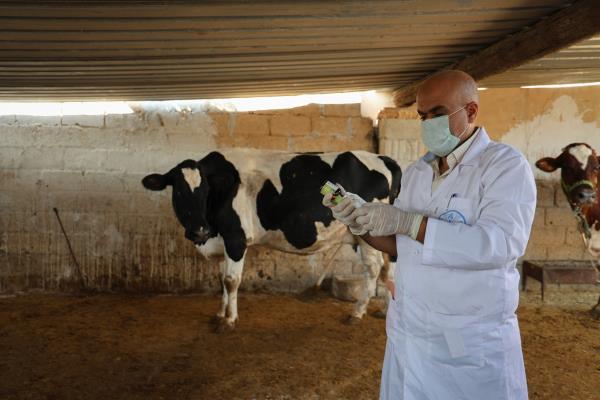
The video below shows what fodder support, veterinary care and artificial insemination look like when they reach livestock keepers.
FAO’s livestock campaign in As-Sweida, Daraa, Quneitra and Rural Damascus, supported by OCHA. Farmers receive high nutrient fodder, animal treatment and artificial insemination to restore and sustain food production during the winter season. The package mirrors the animal health support BLRS delivers (FAO).
Deep dive: farmer field schools (FFS)
FFS are participatory, field-based learning groups in which farmers meet regularly to develop their skills through hands-on experimentation and observation. Livestock FFS aims to strengthen animal health and productivity through practical training in balanced feed formulation, disease prevention, improved management practices and breeding techniques, delivered across three specialisations.
3,363
livestock keepers trained in the cattle FFS. They learnt vaccination protocols, early disease detection and biosecurity.
1,431
livestock keepers trained in the sheep FFS. They learnt the same animal health practices applied to small ruminants.
492
farmers trained in the fodder maize FFS. They learnt how to produce fodder sustainably to feed their livestock.
~6,000
households received direct veterinary services and disease prevention support.
Source: FAO, 2026
What the evidence shows
Impact findings from FAO’s FFS activities in combination with artificial insemination and animal health support, 1.5 years into Phase 1 implementation:
Improved food security
Livestock FFS beneficiaries improved their food security by 9% on the Food Consumption Score and 7% on the Household Dietary Diversity Scale. Roughly 1 in 3 households consumed an additional food group per day, with milk and meat consumption both rising to some degree.
More resilient herds
Amid national destocking of herd sizes (non-beneficiary herds decreased by 18% for cattle and 37% for sheep), beneficiary herds held up far better, with cattle herds only decreasing by 8% and sheep herds by 14%. Sheep milk yield increased by 0.5-1 L/day in Aleppo, Rural Damascus and Deir-Ez-Zor.
Enhanced fodder production
Amid severe drought, fodder maize yields for Livestock FFS participants rose 17% to 6.2 t/ha, supporting on-farm feed supply as pasture and purchased fodder became scarcer and costlier.
Strengthened resilience
The Resilience Capacity Index improved by 12% among Livestock FFS participants, driven by stabilised crop and livestock production and improved on-farm fodder access.
No economic returns yet
In the short term, production and productivity gains have not yet translated into measurable economic returns. This may reflect a general upward trend in household income across the study area, which may mute the programme’s measurable effect.
Resilience against market volatility
Volatile markets can squeeze margins, but on-farm input production can reduce how much households depend on them.
What FCDO funding delivers
Animal health at scale under BLRS Phase 2
Around 86,500 livestock keepers will benefit from preventive and curative animal health services, including artificial insemination to promote healthy and resilient livestock breeds, as part of FAO’s national animal health campaigns.
A three-year UK commitment
FCDO funding supports approximately 114,000 farming households, about 684,000 people, across seven governorates through BLRS Phase 2, running to March 2028, with a focus on women-headed households, people with disabilities, and displaced and returnee families.
FAO / FCDO, August 2025
What Phase 1 already reached
FCDO reports that UK and FAO joint efforts have helped over 500,000 people through agricultural support including seeds, fertiliser and fodder production, water access and irrigation rehabilitation. FAO puts the number of vulnerable rural households impacted at 81,730.
Lessons learnt
ISDC draws six lessons from the Phase 1 findings on animal health and livestock production
Resilience against market volatility
Volatile markets can squeeze margins, and on-farm input production can reduce dependence on those markets. The programme should continue promoting on-farm input production through FFS, and future programmes should pilot measures that buffer market shocks, such as input subsidies during price spikes and storage or sales support when output prices fall.
Livestock resilience and asset recovery
Stabilised livestock numbers and productivity during drought show the value of drought-adaptive management in FFS and advisory services. Artificial insemination and veterinary services may not be enough on their own to rebuild numbers in the short term, so Phase 2 should put more weight on rebuilding productive assets, particularly cattle, and explore livestock insurance, savings schemes and credit to reduce distress sales.
Commercialisation and market linkages
Macroeconomic factors can overshadow programme effects on income. Future interventions should place greater emphasis on commercialisation, for example through post-harvest processing and small-scale commercialisation of inputs such as fodder, and should reinforce market linkages through aggregation mechanisms and farmer cooperatives.
Summary
Syria’s livestock keepers are under sustained pressure from drought, unaffordable fodder, a strained veterinary system and a squeeze on margins. Livestock numbers among households outside the programme fell sharply over the study period.
Against that backdrop, the impact evaluation of FAO’s Phase 1 activities confirms that integrated support, specifically farmer field schools combined with artificial insemination and veterinary care, significantly improved food consumption, safeguarded livestock and crop production, and bolstered short-term resilience.
Income gains have not yet materialised, and female-headed households did not see the same benefits. Phase 2 should continue to prioritise the FFS model while strengthening asset recovery, commercialisation and delivery to the most vulnerable households.
Related stories

This project is funded by UK aid from the UK government.