While social safety nets are vital tools for poverty alleviation, one question remains critical for policymakers: How can interventions effectively build resilience in regions characterized by dense forced displacement and severe infrastructure deficits?
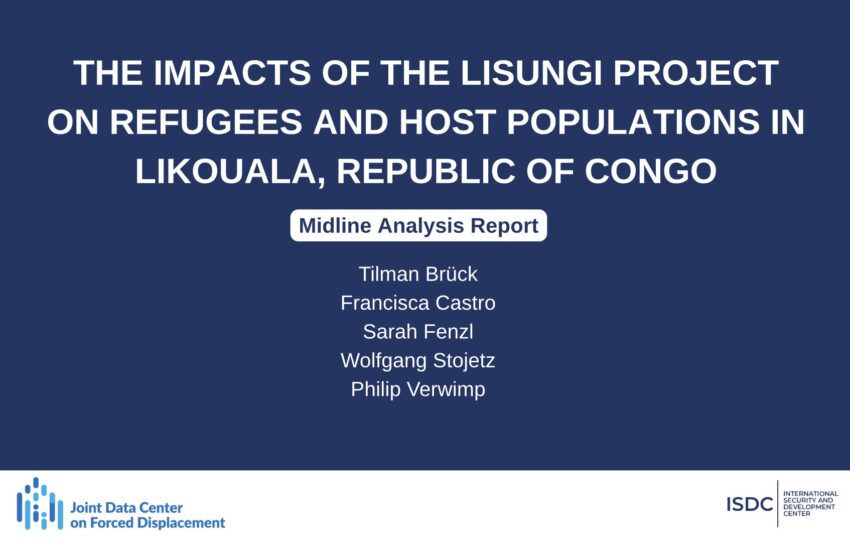
In a new report, “The impacts of the Lisungi Project on refugees and host populations in Likouala, Republic of Congo: Midline Analysis Report,” we evaluate how combining conditional cash transfers with productive livelihood support shapes household well-being and social cohesion. In Likouala, refugees constitute approximately 60% of the population, living alongside Bantu and indigenous communities in a highly fragile context with widespread poverty and limited state capacity.
The Lisungi project (meaning “relief and assistance” in Lingala) was expanded with support from the World Bank’s Refugee and Host Populations financing window. Between 2021 and 2023, the program deployed a comprehensive “cash plus” approach with a total budget of USD 34 million. It provided regular conditional cash transfers (CCTs) tied to school attendance and health check-ups, monetary support for income-generating activities (IGAs), and vital accompanying training on nutrition, hygiene, and intra-household decision-making.
By providing rigorous, large-n statistical evidence from a region where impact evaluations are historically scarce, the study offers crucial insights into the political economy of forced displacement and social protection. The evaluation assesses the program’s midline impacts approximately 18 months after deployment, tracking how these dual financial mechanisms help vulnerable families invest in human capital and break intergenerational cycles of poverty.
This research was produced with technical and financial support from the World Bank–UNHCR Joint Data Center on Forced Displacement (JDC).