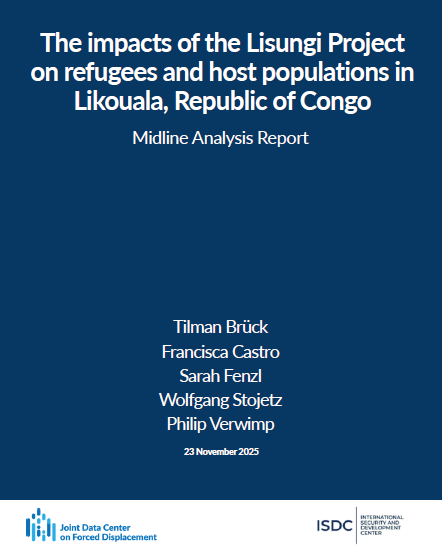
In this new midline analysis report, we evaluate the impacts of the Lisungi Project on refugees and host populations in Likouala, northern Republic of Congo, where refugees make up approximately 60 percent of the population.
Produced with technical and financial support from the World Bank–UNHCR Joint Data Center on Forced Displacement (JDC), the report draws on survey data collected between 2021 and 2023 to evaluate the expansion of this national social protection program. The intervention combined conditional cash transfers with support for income-generating activities alongside practical training in nutrition, hygiene, money management, and household decision-making.
Key insights from the midline analysis include:
- Distinct Program Strengths: Cash transfers primarily helped households meet basic needs, boosting consumption, asset-building, health, and education. Meanwhile, support for income-generating activities drove greater social participation and intra-household decision-making.
- Broader Social Progress: The program contributed to measurable improvements in labor market participation, gender equality, and social cohesion across the department.
- Varied Group Dynamics: Outcomes varied across different demographic groups, with the intervention demonstrating stronger overall impacts among host communities than among refugee populations.
An endline report will follow to assess long-term sustainability using data collected one year after this midline survey.
Find out more and read the full report
Publication Details
- Year of Publication: 2026
- Region/s: Sub-Saharan Africa
- Theme/s: Human Development · Impact Evaluation · Individual Decision-making · Micro-Data Collection · Violence & Peacebuilding
- Research Topic/s: Disasters & Emergencies · Employment · Migration & Displacement · Peacebuilding & Reconstruction · Social Cohesion · Trust and Prosocial Behaviour · Violence & Conflict