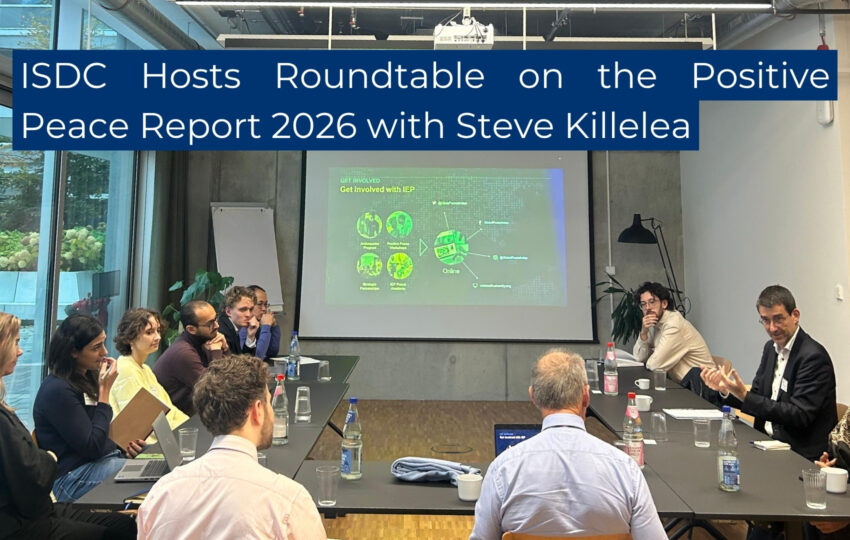
On Friday, 30 October, the International Security and Development Center (ISDC) hosted an interactive roundtable in Berlin to examine the findings of the newly published Positive Peace Report 2026, presented by Steve Killelea, Founder and Executive Chairman of the Institute for Economics & Peace (IEP).
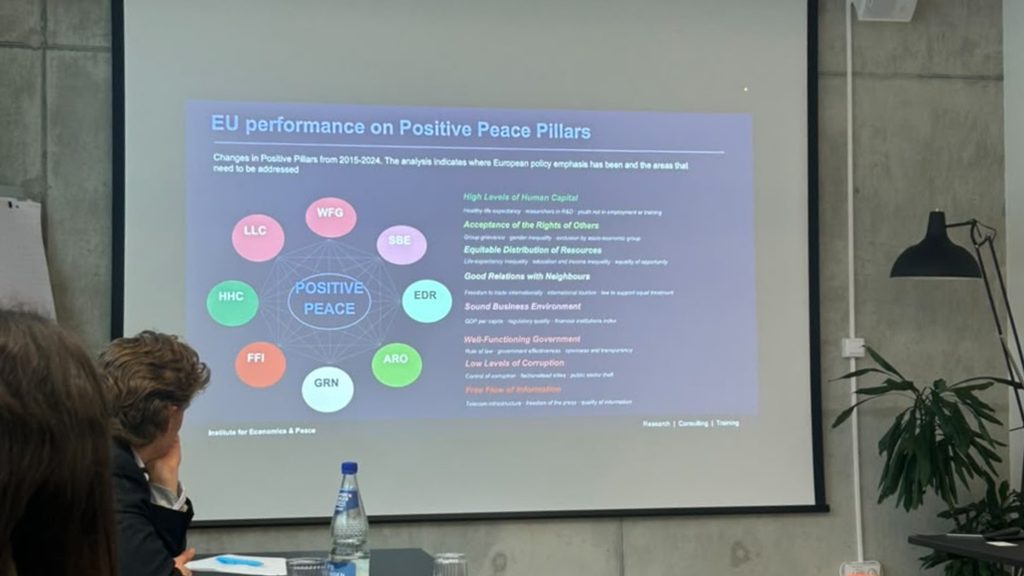
Steve Killelea opened the session by outlining the conceptual and statistical methodology behind Positive Peace. Defined as a human-centered, evidence-based framework, Positive Peace moves beyond the mere absence of violence (“negative peace”) to measure the attitudes, institutions, and structures that create and sustain peaceful, flourishing societies. Drawing on 16 years of research, the Positive Peace Index tracks 24 indicators grouped into eight systemic pillars: a well-functioning government, a sound business environment, equitable distribution of resources, acceptance of the rights of others, good relations with neighbors, free flow of information, high levels of human capital, and low levels of corruption.
The presentation emphasised the measurable economic and societal benefits of positive peace.
- Economic Performance: Empirical findings indicate that countries improving in Positive Peace experience double the real GDP growth rate of deteriorating countries, attract more than twice the foreign direct investment, and report 40% higher GDP consumption alongside significantly lower inflation volatility.
- Resilience to Shocks: According to IEP’s findings, countries with high Positive Peace demonstrated superior resilience during global crises such as COVID-19, recovering at three and a half times the rate of lower-ranked nations.
- Predictive Value: The report’s Positive Peace Deficit Model highlighted that all 16 countries identified with the largest positive peace deficits in 2009 deteriorated by 2024, demonstrating how institutional deficits precede rising instability.
The presentation also offered a detailed analysis of Western nations and Europe. While European countries continue to demonstrate strong results in human capital, education, and inclusion metrics, the data reveals significant institutional and economic strains. Over the past decade, major European economies have seen their global GDP share decrease, accompanied by lagging indicators in business environments, rising corruption perceptions, and measurable drops in government effectiveness. Globally, Steve pointed out that while Positive Peace registered a modest 1.7% improvement over the decade, this progress was largely driven by gains in telecommunications infrastructure; excluding that metric, global Positive Peace remained essentially flat (-0.1%).
Following Steve Killelea’s presentation, Tilman Brück, Founder and Director of ISDC, shared reflections on the report’s findings and opened the discussion to participants.
ISDC was delighted to host Steve Killelea and the Institute for Economics & Peace for this engaging discussion.
The full Positive Peace Report 2026 is available to read via the Institute for Economics & Peace: https://www.visionofhumanity.org/wp-content/uploads/2026/09/Positive-Peace-Report-2026.pdf