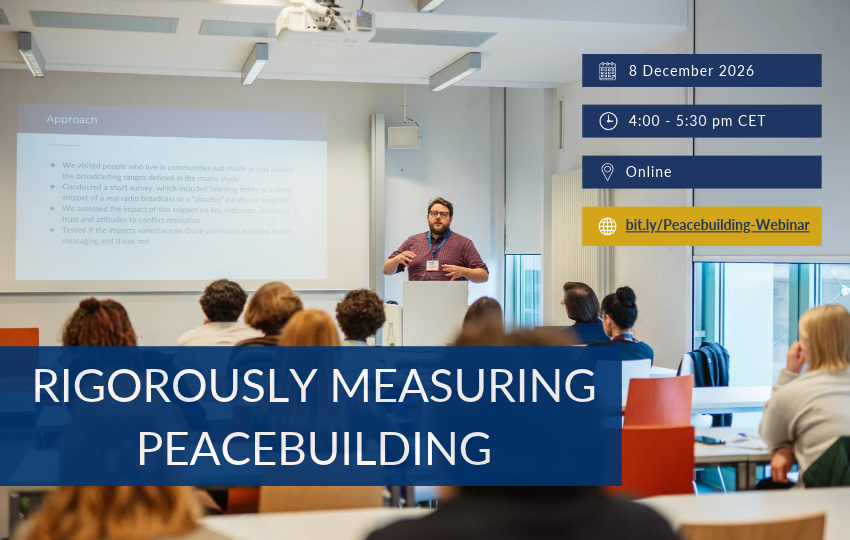
In recent years, calls have been made – and even heeded – to advance rigorous learning around the impact of efforts to build peace. Despite this progress, a key gap remains between the centres of academic learning and the programmatic landscape. Many key peacebuilding strategies remain understudied and even unstudied; while academic learning has often focussed on relatively minor building blocks of global peacebuilding efforts.
This gap is the focus of a recent special issue, published in October 2026 in the Journal of Development Effectiveness. The special issue notes that the intervention types best-suited to building peace are often those least suited to the standard tools of rigorous, quantitative, learning, which calls not only for new topical learning but also the creative adaption of methodologies and approaches to understanding peacebuilding impact. The special issue presents eight new scientific contributions that address these methodological and conceptual gaps. This webinar highlights key new research findings from this special issue. It captures both the topical contributions and methodological advances that underpinned the special issue.
Covering case-studies in Mali / Niger, Guinea / Sierra Leone and Central African Republic, the webinar presents new evidence on how peacebuilding works, as well as new approaches to measuring and understanding these impacts rigorously.
The webinar takes place on 8 December 2026 at 4 pm CET and includes contributions from:
- Suchi Kapoor – Director Research, Campbell South Asia and Senior Fellow, Global Development Network
- Paul Thissen – Senior Evaluation and Communication Specialist, International Initiative for Impact Evaluation (3ie)
- Alexandra Blackwell – Postdoctoral Researcher, University of Copenhagen
- Luke Hosford- Junior Researcher, ISDC – International Security and Development Center