Background
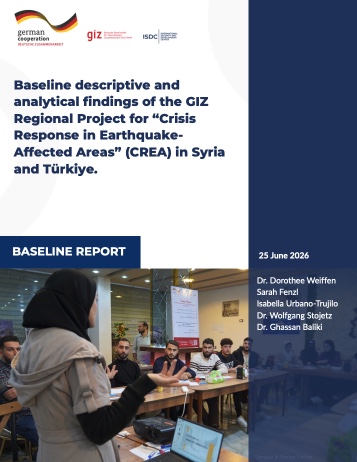
To strengthen the resilience of communities devastated by the 2023 earthquakes in Syria and Türkiye, the GIZ Regional Project “Crisis Response in Earthquake-Affected Areas” (CREA) delivers multisectoral support, for example, training teachers in trauma-sensitive teaching and psychosocial support; establishing savings groups, digital bootcamps, and microcredits; training health staff and providing direct medical services; and delivering community-based disaster response training.
ISDC is conducting an independent, rigorous impact evaluation of the CREA activities in Syria, including the distinct interventions in the education, health, and livelihoods sectors, as well as the effectiveness of the program’s multisectoral approach. Drawing on baseline data from over 3,100 respondents, this baseline report provides a pre-intervention benchmark of household access to services, economic situation, mental well-being, and social cohesion, along with an analysis of how these outcomes interrelate.
Key Findings and Lessons
At baseline, the studied communities are clearly under sustained strain: 77% of households report that they were directly affected by the earthquakes, their average monthly income sits just above the subsistence threshold, and 64% of respondents show signs of depressive symptoms, rising to 78% among patients in the health sector. Yet amid this fragility, access to education and health services remains remarkably high despite persistent service-quality gaps. The baseline findings point to five key lessons for resilience programming in a crisis setting:
- Supply-side deficiencies in services, such as teacher absence, lack of materials, poor hygiene facilities, and insufficient consultation time, undermine satisfaction and trust in these services. Addressing these service delivery gaps is likely to yield improvements in quality ratings, utilization, and trust simultaneously.
- Intersectionality shapes service accessibility: Male respondents with disabilities report higher accessibility deficits for general health services, and households with disabled members consistently report lower income and trust across sectors, calling for interventions tailored to these overlaps.
- Structural barriers to women’s earnings persist beyond financial inclusion: Addressing structural barriers such as market access and social norms may foster women’s individual economic returns.
- Psychosocial well-being is a cross-cutting multiplier: teachers’ mental health shapes students’ well-being, and teachers who use stress-management strategies have less depressed students, validating an MHPSS-centered approach as a foundation rather than an add-on.
- Crises activate social networks, with earthquake-affected households reporting stronger informal support systems even years later, suggesting that formalizing these networks (through VSLAs, peer groups, and parent-teacher associations) can help translate crisis-driven solidarity into lasting community resilience.
Publication Details
- Year of Publication: 2026
- Region/s: Middle East & North Africa
- Theme/s: Human Development · Violence & Peacebuilding
- Research Topic/s: Gender · Peacebuilding & Reconstruction