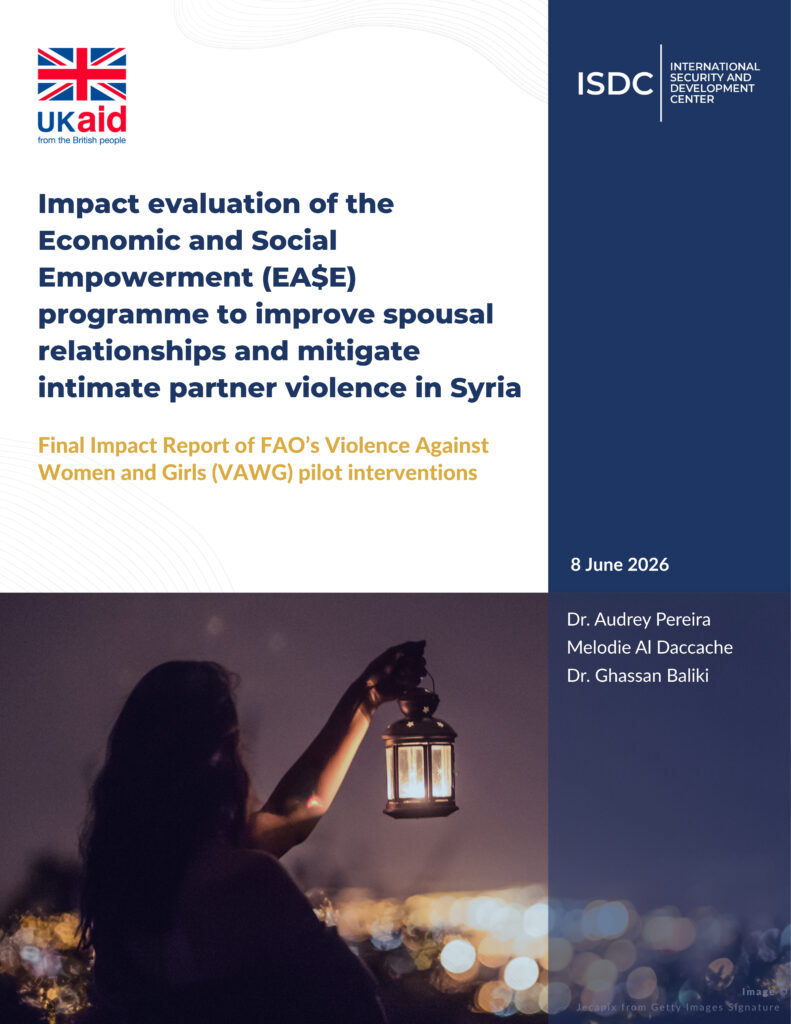
Final Impact Report of FAO’s Violence Against Women and Girls (VAWG) pilot interventions
Executive Summary
Background: Since the onset of the Syrian conflict, women have faced heightened risks of Gender-Based Violence (GBV), particularly Intimate Partner Violence (IPV). In Phase 1 of the Building Local Resilience in Syria (BLRS) programme, the Food and Agricultural Organization of the United Nations (FAO) in Syria, through a strategic partnership with the United Nations Population Fund (UNFPA), is piloting interventions aimed at reducing and preventing Violence Against Women and Girls (VAWG) in Homs and Rural Damascus governorates. The pilot is implemented through Farmer Field Schools (FFS) and combines the provision of agro-processing vouchers worth 400 USD with the Economic and Social Empowerment (EA$E) curriculum to couples. These interventions aim to rebalance intrahousehold power dynamics, mitigate economic and emotional intimate partner violence (IPV), and improve household welfare, with the goal of increasing women’s economic and social participation.
Key Research Findings
Using a rigorous cluster randomized controlled trial (cRCT) involving 581 couples, researchers Dr. Audrey Pereira, Melodie Al-Daccache, and Dr. Ghassan Baliki identified several transformative impacts:
- Reduction in Violence: The program led to a 36 percentage point reduction in women’s reported economic IPV and a 26 percentage point reduction in emotional IPV.
- Enhanced Agency: Women reported significant improvements in joint decision-making, particularly regarding household purchases and employment outside the home.
- Time Redistribution: The intervention successfully reduced the daily time women spend on domestic work.
- Improved Wellbeing: Participants reported higher levels of marital satisfaction, a greater sense of control, and feeling more respected by their spouses.
Why This Matters
This report provides crucial evidence for policymakers, donors, and practitioners working in conflict-affected regions. It highlights the potential of integrated economic and social programming to not only boost household welfare but to fundamentally shift intrahousehold power dynamics and protect women and girls from violence.
To read more about the methodology, findings, and recommendations for future programming, you can download the full report.
Publication Details
- Year of Publication: 2026
- Region/s: Middle East & North Africa
- Theme/s: Human Development · Violence & Peacebuilding
- Research Topic/s: Gender · Peacebuilding & Reconstruction