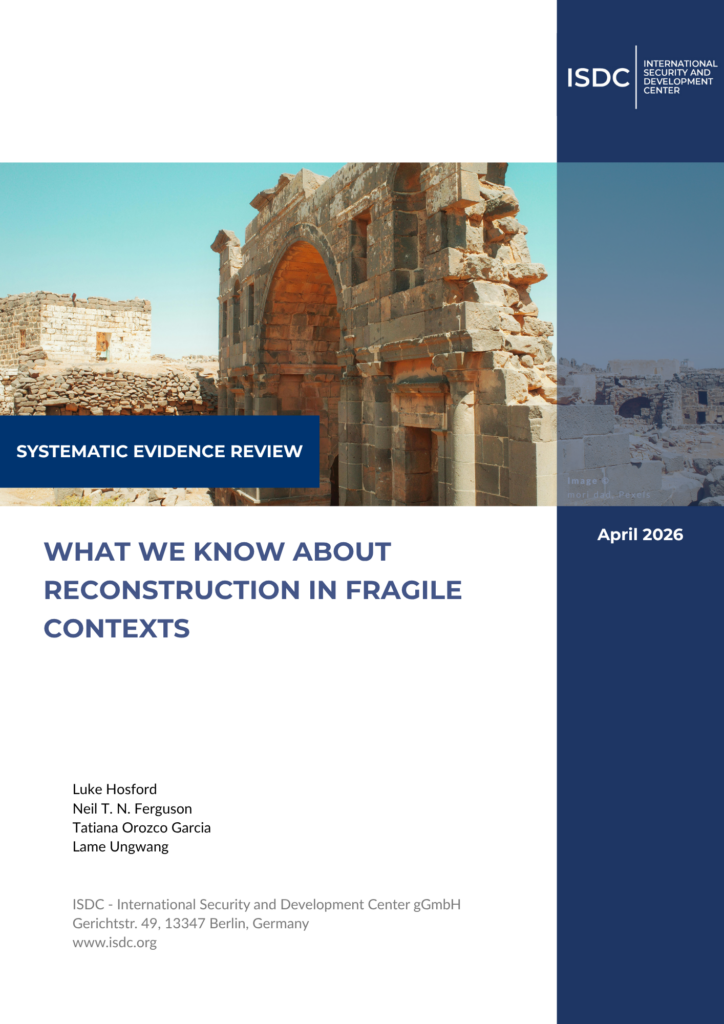
Before, during and after conflict, highly fragile countries face uncertain social and economic futures. Some countries recover, while others fall into conflict traps but all experience the deleterious and costly effects of violence. To support countries to rebuild and towards sustainable social and economic stability, BMZ draws on Transitional Development Assistance (TDA), which is designed to support the reconstruction of physical infrastructure in highly fragile and conflict-affected places. Especially in the current climate, when needs for reconstruction support are increasing, while budgets come under increasing pressure, it is important to understand if this support works towards achieving its aims and how it does so.
To this end, this research undertook a series of structured reviews of academic, grey and agency literature to understand the quantity and quality of evidence that connects key infrastructure development inputs to both direct and downstream impacts. We consider eight main thematic areas, which have been the main focus of TDA investments in recent years: WASH, Institutions, Civic Engagement, Peacebuilding, Economic and Livelihoods Interventions, MHPSS, Health and Education. We consider evidence produced in all countries that have received TDA in recent funding cycles, as well as an additional list of highly fragile places that are, in principle, eligible to receive TDA and consider relatively recent evidence produced in the last 10 years. Studies were identified using keyword searches of major research databases, then evaluated for their relevance to the geographic, temporal and thematic scope of the review.
The research took a hierarchical approach to sorting evidence. First, causal evidence was collected from randomized control trials and quasi-experimental impact evaluations of key relationships. When key relationships could be confirmed from such studies, no additional information was sought. When this evidence was absent or inconsistent, additional inputs were considered, which were identified through searches of the document libraries of key donors and implementers.
Overall, we find that while the full universe of evidence on the key themes of this work is large, only a very small proportion of this work focuses on evaluations of infrastructure interventions in highly fragile settings. Accordingly, only 99 causal impact evaluations and less than 200 documents overall were reviewed in depth in this analysis. In this regard, even when there is evidence of causal learning, key takeaways typically rely on fewer than five studies. Key findings should, therefore, be understood in the context of the relatively lack of recent evidence in this field.
Despite this, in some areas knowledge is comparatively strong. WASH infrastructure, including wells, boreholes and latrines, are frequently observed to improve access, quality and satisfaction. Infrastructure in support of institutions and peacebuilding are associated with positive outcomes for local economies, as well as cooperation in those communities. By contrast, knowledge is more limited in other areas. For example, despite substantial evaluations of livelihoods programming more broadly, the reviews uncover no evidence linking livelihoods infrastructure to key outcomes. There is little evidence that supports links between infrastructure inputs and long-term outcomes generally, nor that related to long-term economic and social stability. Key amongst these gaps is that there is little evidence that assesses the extent to which reconstruction support can, in the long-term, prevent countries from sliding back into crisis. This is a key goal of TDA and future work should be supported to close these high-level gaps.
Publication Details
- Year of Publication: 2026
- Region/s: Global
- Theme/s: Human Development · Shocks & Livelihoods · Violence & Peacebuilding
- Research Topic/s: Disasters & Emergencies · Education · Employment · Health · Institutions & Fragility · Peacebuilding & Reconstruction